
Precious metals are apparently waking up. And here is where you can find the best deals.


Site:
Precious metals news


“This referendum is nonbinding and only Congress can change Puerto Rico’s status,” the White House said in a statement.

Illinois has compiled $14.6 billion in unpaid bills. It’s running a deficit of $6 billion, and its pension liability has soared to $130 billion.

As a part of the settlement, Deutsche Bank did not admit any wrongdoing. It settled to avoid the cost of further litigation, as its legal expenses have surpassed €15 billion ($16.8 billion) since 2009.


Analysts at the World Gold Council say they believe a new tax plan set to go into effect in India will ultimately boost demand for gold in the world's second-largest market for the yellow metal.On July 1, India's current labyrinth of taxes will be replaced by a nationwide Goods & Services Tax (GST). The World Gold Council called it the "biggest fiscal reform since India’s liberalization in the early 1990s."While gold consumers will face a slightly higher tax rate, and the industry will go through a period of adjustment, we see the net impact on the gold industry as being positive. The gold supply chain should become more transparent and efficient, and the tax reform can boost economic growth, which we see as supporting gold demand."

Germany continues to bring its gold home.In early 2013, the Bundesbank announced a plan to repatriate massive amounts of its physical gold reserves back into Germany. The goal is to have half of its gold back within the country’s borders by 2020. At nearly 3,400 tons, Germany’s gold reserves currently rank as the second-largest in the world.

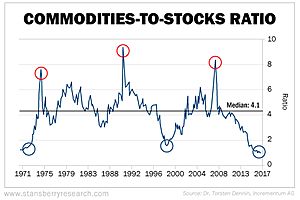
Today’s historic lows suggest “real” assets could once again be set to beat financial assets over the next several years.


By the late 1960s, there were far more dollars in global circulation than could be covered by the 8,000 tons of gold held by the U.S. Treasury. Essentially, the U.S. had written cheques (U.S. dollars) that could never be cashed (exchanged for gold).
To solve this problem, U.S. President Richard Nixon


Around 80% of the timber used in U.K. construction is imported, mainly from Scandinavia, according to the Timber Trade Federation. It isn't easy for Britain's construction industry, which is responsible for around 7% of GDP, to shift quickly to domestic suppliers.
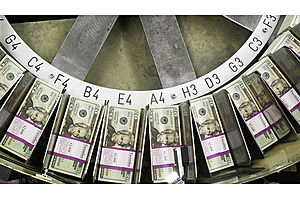
Last Friday may be a one-off, but it may also be central banks pulling the plug on their direct ownership of the stock market, or hoarding of tech stocks


It’s acceptable to build infinitely high levels of household debt - as long as rates never rise.

Higher interest rates will triple the interest on the federal debt to $830 billion annually by 2026, will hurt workers and young voters, and could bankrupt over 20% of US corporations, according to the IMF. The move is not necessary to counteract inflation and shows that the Fed is operating from the wrong model. Responding…
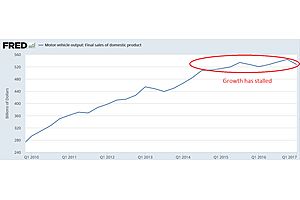
The collapse continues. With total bank credit just over $12.5 trillion, it’s about $500 billion less than it would have been had last year’s loan growth continued. If this lower rate of loan growth continues, and isn’t replaced by some other channel that facilitates agents spending more than their incomes, the implication is that GDP …

It could save us all from economic disaster! & it isn’t even hard to grasp or complicated to do. It’s simple, in fact. Reinstitute the Glass-Steagall Act.

Fitch Says 2015 May Be Worst Ever, Mish Says 2017 Will Be Even Worse

Leverage is excessive, structural problems have not been fixed and the ECB has repeatedly kept its bond purchases alive.


The global economy is set for a dramatic collapse some time in the second half.
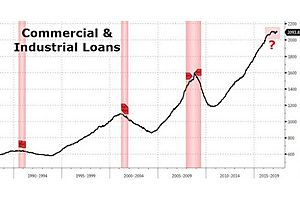
We only note this, because next week the Fed plans to hike rates again. If it does so just as US loan growth contracts, it may be doing so smack in the middle of a recession.

As much as I try, I simply cannot jump on the bandwagon that says that printing up money out of thin air has any long-term utility for an economy.It's just too clear to me that doing so presents plenty of dangers, due what we might call 'economic gravity': What goes up, must also come down.

While the U.S. government can seemingly borrow and spend without limits, the U.S. consumer appears to be nearing the end of its rope. Somehow this always seems to happen at the worst possible time.

Most people’s lives are dedicated to money. It’s all people ever worry about or talk about. People train to learn the skills to get jobs to trade hours of their lives for money. But where does money come from? And who controls it? This 21-minute video from ColdFusion explains it all.